




What Is a Non-VBV CC ? In 2026, & Why Does It Matter to E-Commerce?
 BlackopsJuly 5, 202611 Mins read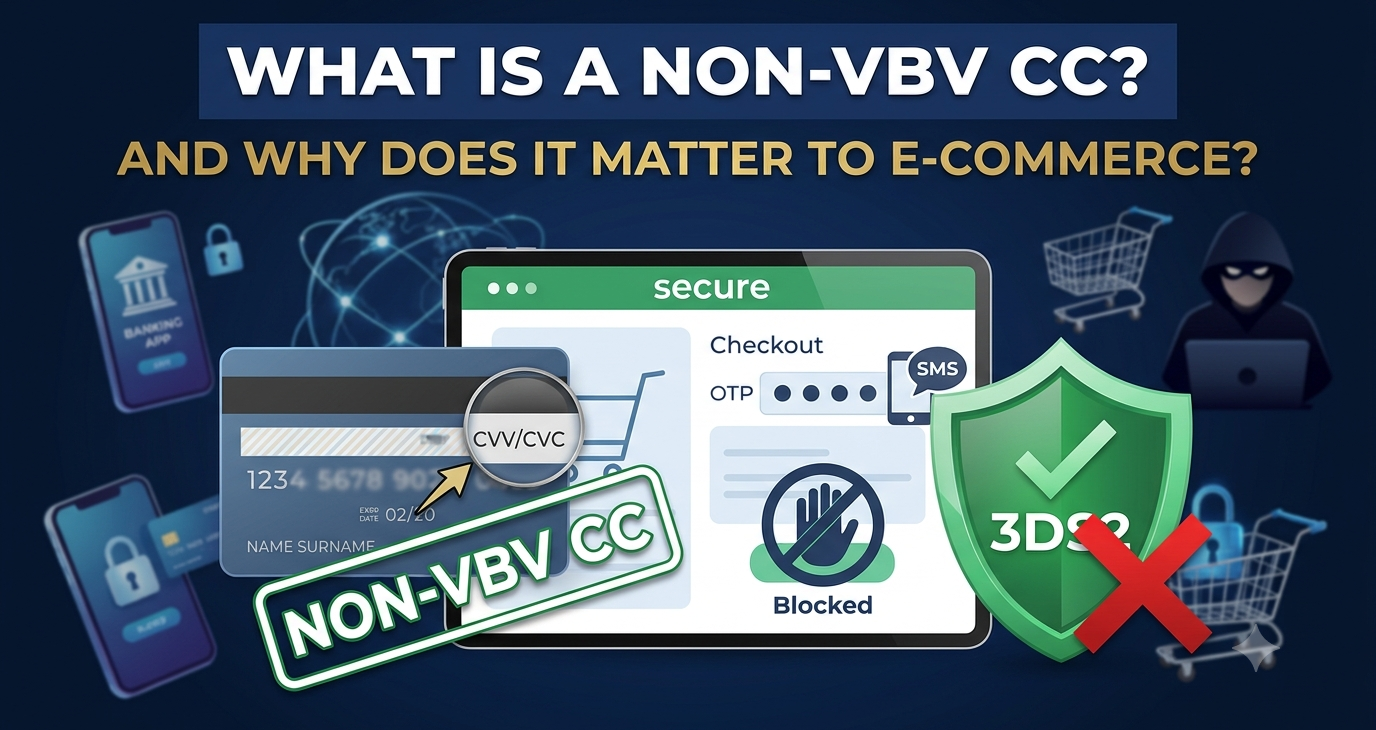

What Is a Non-VBV CC ? Demystifying the Digital Checkout The global e-commerce landscape is expanding at a breakneck pace. As millions of digital transactions occur every single minute, a highly sophisticated financial ecosystem operates quietly behind the scenes to keep our money safe. Most consumers click “Buy Now” and expect their goods to arrive without a second thought. But behind that seamless checkout lies an ongoing invisible war between financial security protocols and digital fraud networks.
If you have spent any time reading technical cybersecurity whitepapers, browsing payment gateway documentation, or exploring online financial forums, you may have crossed paths with a highly specific, somewhat cryptic piece of jargon: the “Non-VBV CC.”
TRENDING>List of Non VBV BINs 2026 – Non-VBV / MSC Updated
To the uninitiated, this string of letters looks like harmless corporate alphabet soup. To e-commerce merchants, cybersecurity analysts, and risk management professionals, however, it represents a massive vulnerability in the global payment pipeline.
This deep dive breaks down what a non-VBV CC actually is, explores the hidden mechanics of modern online card security, and uncovers why this specific type of card has become a highly sought-after commodity on the dark web.

1. The Anatomy of an Online Card Transaction
To fully grasp what a “Non-VBV” card is, we first have to review how standard online credit card transactions work. When you pay for a meal at a physical restaurant, you either dip your card’s EMV chip or tap it via contactless payment. Your physical presence, combined with the encrypted chip on your card, provides a strong layer of proof that you are the authorized user.
Online shopping is entirely different. It falls under a category known as Card-Not-Present (CNP) transactions. Because the merchant cannot physically see you or verify your ID card, they have to rely on a few static pieces of data passed through a digital payment gateway:
- The Primary Account Number (PAN): The 16-digit number on the front of the card.
- The Expiration Date: The month and year the card expires.
- The Card Verification Value (CVV/CVC): The 3- or 4-digit security code usually printed on the back.
- The Billing Address: Used for Address Verification Service (AVS) checks.
For decades, this was all it took to buy something online. However, this structure creates a glaring security flaw. If a malicious actor intercepts your card data through a database breach, a phishing email, or a physical card skimmer, they have everything they need to impersonate you online. They don’t need your physical card; they just need those text fields.
Because basic CNP data is inherently vulnerable to theft, the card networks (Visa, Mastercard, American Express) realized they needed a digital equivalent of the physical chip-and-PIN system. This realization gave birth to the 3D Secure (3DS) protocol.
READ ALSO >Non VBV BIN Security in 2026 — What Merchants & Researchers Need to Know
2. Breaking Down the Acronyms: What is VBV?
VBV stands for Verified by Visa. It is Visa’s proprietary implementation of an underlying technical standard called 3D Secure (3DS).
The “3D” stands for the “Three Domains” that collaborate to secure the transaction:
- The Acquirer Domain: The merchant’s bank and payment gateway processing the money.
- The Issuer Domain: The bank that issued the credit card to the consumer (e.g., Chase, Bank of America).
- The Interoperability Domain: The infrastructure provided by the card network (like Visa or Mastercard) to connect the merchant and the bank.
(Acquirer Domain)
(Interoperability)
(Issuer Domain)
Mastercard has its own version of this standard called Mastercard Identity Check (historically known as SecureCode). American Express calls theirs SafeKey. While the marketing names differ, they all run on the exact same underlying technology.
BEGINNERS ENJOY>Cardable Sites : A Cybersecurity & E-Commerce Defense Guide 2026

How a VBV / 3DS Check Works in Real Life
When you check out at a retailer that uses a 3DS-enabled payment gateway with a modern credit card, the payment flow doesn’t just immediately approve or deny the charge. Instead, a multi-factor authentication (MFA) step is triggered:
- You enter your 16-digit card number and CVV.
- The payment gateway recognizes that the card is enrolled in the VBV/3DS network.
- An embedded window or a quick redirect loop connects your browser directly to your card-issuing bank.
- The bank challenges you to prove your identity. This is typically done via a One-Time Password (OTP) sent to your registered phone number via SMS, an email code, or a push notification requiring you to log in to your mobile banking app using biometrics (FaceID/Fingerprint).
- Only after you successfully provide this second factor does the bank greenlight the transaction, passing an encrypted authentication token back to the merchant to finalize the sale.
This secondary verification process completely neutralizes basic identity theft. Even if a bad actor manages to buy a list of 10,000 credit card numbers, expiration dates, and CVVs from an illicit marketplace, they cannot use those cards at a 3DS-protected merchant because they don’t have the victim’s physical smartphone to read the incoming SMS verification codes.
3. What Exactly is a Non-VBV CC?
Now that we understand the defense system, we can define the exception. A Non-VBV CC (Non-Verified by Visa Credit Card) is a credit card that completely bypasses this multi-factor authentication protocol.
YOU CAN THIS NON VBV CC FROM DARKSWIPES.CC
When a merchant processes a transaction using a non-VBV card, no security pop-up appears, no SMS verification code is sent, and no mobile app approval is required. The payment gateway acts exactly like an old-school online checkout system from the early 2000s: it looks at the 16 digits, check the expiration date, matches the CVV, and instantly prints an approval code.
Key Concept: A non-VBV transaction removes the step-up verification layer, relying purely on static numbers. In formulaic terms of transaction authentication data validation, Auth = {PAN, EXP, CVV} without the dynamic token T_{MFA} required by standard protocols.
Why Do Non-VBV Credit Cards Exist?
Given the obvious security risks, you might wonder why any bank would allow a credit card to float around without these modern safety nets. There are two primary reasons why a card can be classified as non-VBV:
DON’T MISS>Dumps with Pin Sites 2026 : The Latest Fresh Guide You Can Trust
A. Outdated Infrastructure at Small Financial Institutions
Implementing the complex infrastructure required for 3D Secure 2.0 requires significant capital, technical integration, and continuous software upkeep. While massive global banking conglomerates have no trouble deploying these systems, smaller financial entities—such as local credit unions, regional banks in developing economies, or smaller fintech companies offering basic prepaid cards—often lag behind in adopting the latest payment security architectures.
B. Regulatory and Regional Variances
Payment security protocols are not globally uniform. In some regions, multi-factor authentication for digital transactions is strictly mandated by law. For instance, the European Union’s Payment Services Directive 2 (PSD2) legally requires Strong Customer Authentication (SCA) for almost all e-commerce transactions. This means non-VBV cards are practically nonexistent within the EU.
Conversely, in countries like the United States, 3D Secure is heavily encouraged by card networks but is not universally mandated by federal law. Because of this open legal landscape, many cards issued by mid-tier U.S. banks or specific types of prepaid card companies remain non-VBV by default.
4. The Threat Landscape: Why Fraudsters Hunt for Non-VBV Cards
In legitimate developer environments, network engineers use technical terms like “non-3DS cards” or “cards not enrolled in identity check protocols.”
However, if you drop the specific phrase “Non-VBV CC” into an internet search engine, you won’t find many clean enterprise banking manuals. Instead, you will plunge into an underworld of underground hacking forums, dark web marketplaces, and encrypted instant messaging channels (like Telegram).
To cybercriminals and identity thieves, non-VBV cards are considered liquid gold. Here is why they are targeted so aggressively:
RELATED.iPhone Carding Playbook : The Ultimate Working Guide 2026
The Missing Gatekeeper
In the underground cybercrime economy, an activity known as “carding” involves utilizing stolen credit card information to purchase high-value physical merchandise (such as laptops, smartphones, designer clothing) or digital commodities (like gift cards and crypto) with the intention of reselling them for clean cash.
If a cybercriminal buys a batch of stolen cards and attempts to use a standard VBV/3DS card at a major retailer like Apple, Best Buy, or Amazon, their operation hits a brick wall the moment the payment system demands a mobile app push confirmation or an SMS OTP code. The true owner of the card gets a sudden text notification, realizes someone is trying to use their card, and immediately freezes the account. The fraudster walks away empty-handed.
With a non-VBV card, however, that entire defensive wall vanishes. The cybercriminal simply types in the card details, hits enter, and the transaction is instantly approved. They can place massive orders and have items shipped to a package drop address before the legitimate cardholder even realizes their data has been compromised.
The Categorization of Illicit “Bins”
To maximize their efficiency, advanced digital shoplifters maintain highly detailed databases of Bank Identification Numbers (BINs). A BIN refers to the initial six to eight digits of a credit card number. These specific numbers identify the exact bank that issued the card, the card type (debit, credit, platinum, prepaid), and its geographic point of origin.
Fraud networks constantly test thousands of stolen cards to map out which specific banking BINs are non-VBV. Once a specific bank’s BIN is flagged as lacking 3DS enforcement, that precise data string becomes highly monetized in underground digital markets, commanding premium prices because it guarantees an effortless checkout experience for unauthorized transactions.
5. The E-Commerce Perspective: What Merchants Must Know
For digital entrepreneurs and e-commerce companies, ignoring the reality of non-VBV cards can quickly destroy a business’s bottom line. When a fraudster uses a stolen card to purchase a item from your store, the actual cardholder will eventually look at their monthly statement, spot the unauthorized charge, and call their bank to lodge a dispute.
This process triggers a chargeback. The merchant does not just lose the money from the sale; they also lose the physical merchandise already shipped out, and they are slapped with a painful punitive chargeback processing fee (often ranging from $15 to $50 per incident) from their payment processor.
The 3D Secure Liability Shift: A Crucial Shield
To incentivize businesses to implement advanced checkout infrastructure, card networks like Visa and Mastercard established a powerful financial rule known as the Liability Shift. This rule fundamentally changes who holds financial responsibility when fraud occurs.
| Transaction Type | Security Layer Used | Who Pays for Fraudulent Chargebacks? |
|---|---|---|
| Standard Transaction | Basic Details Only (No 3DS) | The Merchant (You bear 100% of the loss) |
| 3DS Protected Transaction | Full 3DS Challenge or Frictionless Flow | The Card-Issuing Bank (The bank covers the loss) |
How This Applies to Non-VBV Cards
What happens if you, the merchant, fully implement the latest 3DS security protocols on your website, but a customer tries to buy an item using an older non-VBV card that physically cannot participate in the verification check?
Because you did your part by offering the secure checkout framework, the liability shifts away from your business. Depending on the specific card brand network rules (Visa generally offers broader coverage here than Mastercard if a card is completely incapable of participating), the transaction is flagged as an “attempted authentication”. If that transaction later turns out to be fraudulent, the card-issuing bank has to swallow the cost of the chargeback, protecting your store’s revenue.
6. How E-Commerce Store Owners Can Protect Themselves
If you manage a digital storefront, you cannot afford to leave your security entirely up to chance. Relying blindly on standard payment fields invites coordinated attacks from fraud rings. Here are the core actions you should take to protect your operational revenue:
A. Deploy EMV 3D Secure (3DS2) Immediately
DON’T SKIP>Paypal Carding Method for Beginners 2026 : Ultimate Guide
If your store still uses an outdated payment gateway integration that relies on standard checkout fields, prioritize an upgrade to the latest iteration of 3D Secure (currently EMV 3DS 2.2 or 2.3).
Older 3DS 1.0 frameworks were widely disliked because they forced customers to remember static passwords, which drastically increased shopping cart abandonment rates. The updated 3DS2 framework changes the game by collecting over a hundred rich behavioral and device data points (such as device IDs, IP addresses, and geographical contexts) quietly in the background.
If the transaction parameters look totally safe and normal, the customer experiences a frictionless flow—they get instant approval without ever seeing a disruptive security screen. The step-up authentication challenge is preserved strictly for transactions flagged as high-risk.
B. Implement AI-Driven Fraud Risk Scoring
In addition to standard banking protocols, integrate intelligent fraud prevention layers like Sift, Signifyd, or Radar. These systems look at behavior pattern vectors that standard bank tools miss. They track indicators such as:
- Rapidly typing card digits inside checkout forms (often implying automated copy-pasting from a criminal card list).
- Discrepancies between the user’s actual browser location and the card’s designated billing country.
- Multiple rapid purchase attempts across completely different card numbers within minutes.
C. Set Up Custom Gateway Gatekeepers
If you notice a sudden wave of high-dollar fraud originating from non-VBV cards, configure custom processing logic rules within backend payment gateways like Stripe or Adyen. You can create rules that state: “If a transaction fails to authenticate via 3DS, and the order value exceeds $100, automatically route the payment to a manual operational review queue before allowing fulfillment.”
7. Comprehensive FAQ (Frequently Asked Questions)
VBV stands for Verified by Visa. It is a customer-facing security protocol created by Visa to verify a cardholder’s identity during digital online transactions, serving as their branded rollout of the universal 3D Secure (3DS) technology standard.
Yes, owning a non-VBV card is perfectly legal. Whether a card supports VBV/3DS depends on the bank that issued it, not the consumer. Many consumers hold perfectly legitimate, standard credit cards issued by local credit unions or regional banks that simply haven’t implemented the infrastructure for 3D Secure verification.
However, buying, trading, or utilizing stolen non-VBV credit card details belonging to someone else is a severe federal offense classified under identity theft and wire fraud.
Fraud groups utilize specialized software scripts known as “checkers” or “gateways.” They route stolen card details through websites known to have basic, unprotected payment systems. If the card processes immediately without prompting an SMS or 3D Secure verification step, the card is automatically sorted into a high-value “non-VBV” database list.
YOU MAY LIKE>UNIBET CARDING METHOD 2026 : CASHOUT EASY AND FAST
Yes, this happens automatically on the banking side. When a financial institution upgrades its backend technology systems and integrates with the global EMV 3D Secure card networks, all previously issued cards under their umbrella gain these modern authentication capabilities. The physical card number stays exactly the same, but the payment processing routes adapt to support security verification prompts.
Digital wallets handle transaction security differently. When you upload a credit card to Apple Pay or Google Pay, the wallet creates an encrypted token that replaces your raw card details. Because these transactions require you to physically unlock your mobile device using biometrics (like FaceID or fingerprint scanning) at the exact moment of purchase, they satisfy modern security demands. They provide strong protection against fraud without relying on standard SMS text challenges.
The easiest way to check is to look at your past online shopping history. If you have made purchases at major retailers and your bank regularly prompts you with an inline pop-up window asking for a text message code or requiring you to open your mobile banking app to confirm the purchase, your card is fully enrolled in a VBV/3D Secure program. If you have never encountered a verification screen across years of online shopping, your card may be a non-VBV card.
Conclusion: Securing the Future of Digital Commerce
The phrase “non-VBV CC” highlights a critical structural gap in global e-commerce. While these cards are simple artifacts of older banking systems or regional regulatory differences, their lack of multi-factor authentication makes them prime targets for modern cybercriminals.
For everyday consumers, this underscores the importance of enabling push notifications on your banking apps and reviewing your statements regularly to flag unauthorized activity early. For online merchants, running an enterprise without 3D Secure protections is no longer a viable option. By embracing advanced, background-driven authentication frameworks like 3DS2, businesses can protect their hard-earned revenue while continuing to provide a smooth checkout experience for legitimate shoppers.
READ NEXT>>💳 Carding in 2026: How It Works— and How to Stop It




Related Articles

2026’s Carding Tutorial for Beginners: Latest Update Master the Basics
Introduction For Carding Tutorial for Beginners 2026 You’ve heard the stories. “People...
800+ Non VBV Cardable Sites (Non-VBV) Still Working 2026 !
Here is our most recent global list of non-VBV cardable sites. The...


List of Non VBV BINs 2026 – Non-VBV / MSC Updated Version .
List of Non VBV BINs 2026 . Businesses and consumers alike rely...
